
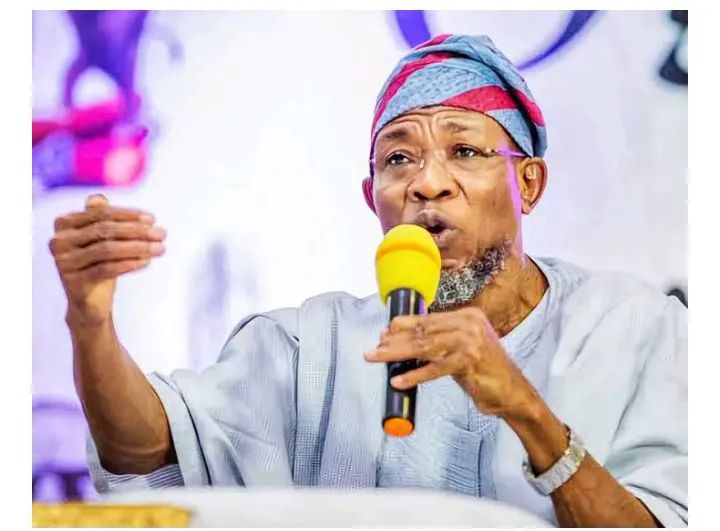
Rauf Aregbesola, who serves as the National Secretary of the Action Democratic Congress (ADC), has voiced strong criticism of what he sees as a concerning trend in Nigeria’s political scene. He pointed out that individuals who have contributed to internal conflicts within major political parties are being celebrated rather than held responsible.
He shared these opinions during a television interview on Arise TV, where he expressed worries about changing moral values in the country’s politics.
Aregbesola specifically mentioned the current issues within the Peoples Democratic Party (PDP), asserting that those who played a role in the party’s fragmentation are now being seen as clever politicians. He questioned this viewpoint, implying that acknowledging such figures diminishes ethical standards in governance and society.
In his view, actions that harm political structures should not be considered as strategic expertise.
In the course of the discussion, he remarked, “Just as nothing can prevent the sun from rising, the ADC cannot be halted either. There has never been a time in our nation when our moral guidance has been as distorted as it is now.
Those who intentionally divided the Peoples Democratic Party are wrongly honored as political experts. When did wrongdoing become a tactic?”
Beyond discussing the need for accountability in politics, Aregbesola underscored the autonomy of the ADC. He asserted that the party is not dependent on any person, interest group, or election authority. Rather, he highlighted that the ADC’s legitimacy stems from the Nigerian constitution and the will of the citizens.
He further noted that the right to form political associations is a basic freedom protected by law, which strengthens the party’s role as a valid avenue for democratic engagement.
Aregbesola stated that this legal support helps ensure that the ADC remains a trustworthy and independent political entity, no matter the outside influences.
His statements echo wider issues regarding political honesty and the necessity for accountability in Nigeria’s democracy, especially at a point when public faith in institutions is facing serious difficulties.