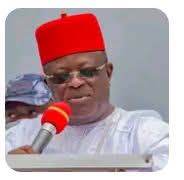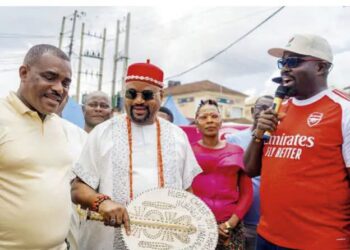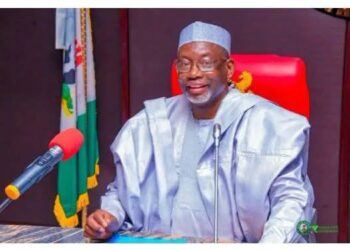

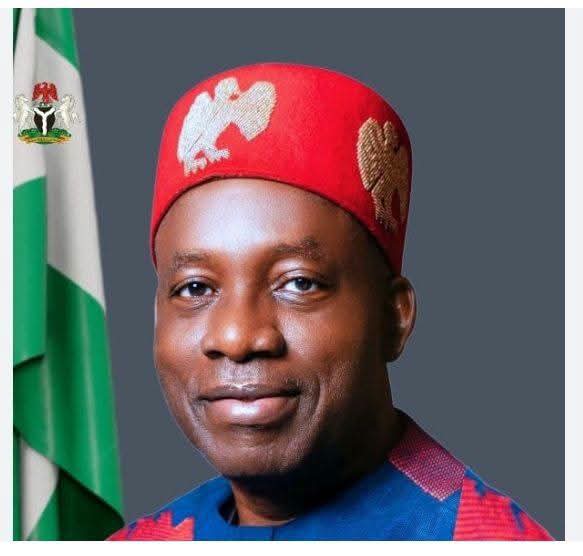
Anambra State Governor Chukwuma Soludo yesterday said he dumped a World Bank facility granted the state because of its high interest burden.
Soludo, who spoke yesterday in Asaba at the ongoing Delta State Economic Investment Summit, said even if the World Band had offered to cut the interest to zero, he would still not have accommodated it, because it would still have remained a drain on the state’s finances.
His words: When I became Governor, I withdrew Anambra State from an ongoing World Bank programme. Anambra was the only state that pulled out. Why? Because the macroeconomic fundamentals, particularly the foreign exchange distortions, were such that I told the World Bank that even at zero per cent interest, it was still the most expensive loan in the world.
‘’ Because if you gave me money and I converted it at N460 to the dollar, knowing that the exchange rate would soon move beyond N1,000 to the dollar, then even at zero interest, the effective cost of that loan would exceed 100 per cent. That is why Anambra pulled out,” saying today, that situation has changed
He said one key message that emerged from President Bola Tinubu’s reforms is that, from a macroeconomic standpoint, Nigeria has stabilised and is on the rise.
Nigerian Politics Coverage
“That brings me to a point you made, Mr. Governor. “
He continued: “You and I are on the same page. I haven’t borrowed a dime since I became Governor. However, I would hesitate to make the additional statement you made—that you will never borrow.
“If you look at what you’ve just said, and indeed as the theme of this conference -’Unlocking Opportunities,’ Nigeria presents a paradox. The macroeconomic stability we have achieved is something to celebrate because we must remember where we are coming from.
“In breaking the paradox of the Nigerian economy, we have moved from being a capital-scarce economy that was simultaneously experiencing massive capital flight—a double jeopardy—to one that is seeing improvements.
“Today, we have net foreign exchange reserves of a little over $40 billion and gross reserves of about $52 billion. The exchange rate has become much more stable and predictable.
“Therefore, Delta State, Nigeria and indeed all our sub-national governments will require capital—whether African capital or capital from anywhere else in the world. We need investment, and today’s macroeconomic environment is far more supportive of that.
“So, I wouldn’t make borrowing an absolute principle, rather, I would say: don’t borrow unnecessarily, but welcome investment. As was rightly said, you may not borrow, but you can certainly invite capital to invest.
“Flowing from what I have heard today, it is clear that we must work together.
Delta is one of Nigeria’s 36 states, alongside the Federal Capital Territory and the Federal Government, not to mention our 774 local governments. “Delta alone can make progress, but together we can achieve much more.
I particularly want to emphasise the relationship between Delta and Anambra.
“With the completion of the Second Niger Bridge, our relationship is much like that between New York and New Jersey—we are now effectively twin economies.
“We should move beyond our personal friendships and institutionalise collaboration between our states. There are many areas where Anambra can leverage what Delta is doing, and equally many areas where Delta can benefit from what Anambra is building.
“You have an economic free zone. We are developing a new commercial and industrial city powered by a thriving metropolis. We have much in common, and we should deliberately create synergies.
“I was also pleased to hear the Chairman of this Summit emphasize that this will not become another talking shop. I particularly like what is scheduled to follow the Vice President’s address—the networking and deal-making sessions.
That is what matters.
“I have organised two investment summits myself, but at the end of the day, it is the deals that count.
“Let’s keep it simple: investment should become a habit, not an event. It should not be something we gather to discuss once in a while. It should become a continuous process.
“There is one area I believe the President, working with the Governors through the National Economic Council under the leadership of our Vice President, will need to address after these reforms.
“ We need a national, coordinated Marshall Plan that translates these macroeconomic gains into real benefits for ordinary Nigerians—more jobs, lower poverty, and improved living standards.”
He added: “Let me leave you with one final thought. We cannot create the number of jobs we need if we continue to patronise imported goods.
Look around this room. Many of the suits we are wearing come from Europe, America, or China.
“I agree completely with the point that was made earlier: we must promote African products. Personally, I am wearing Akwete fabric today. Akwete is named after a community in Abia State, and I adopted it as my regular attire in 2019.
“Since then, I have seen how demand has increased, creating more employment and improving the incomes of the women who produce it.
“Just two or three weeks ago, the President approved a ₦2 billion intervention to help scale up Akwete production. That is exactly the kind of support we need.
“Imagine if all 247 million Nigerians consistently bought and wore Made-in-Nigeria products. We would create well over 10 million jobs. So, I leave you with this challenge.
“Perhaps at the next Delta Investment Summit, we should make it a rule: if you are not wearing Made-in-Nigeria, you don’t come. That is how we move from talking the talk to walking the talk,” Soludo added.