

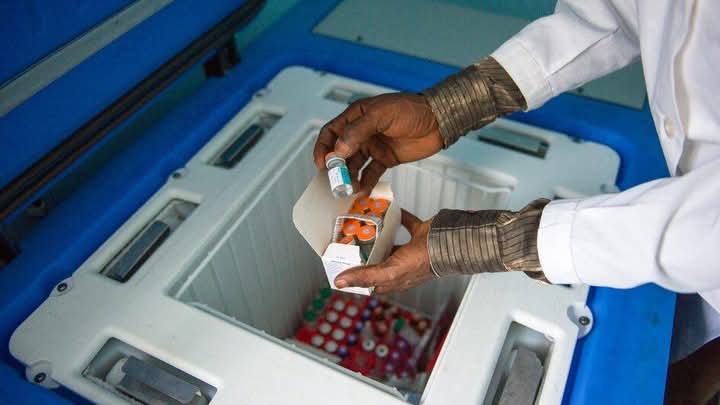
States in the Northwest and Northcentral regions are set to benefit the most from the federal government’s distribution of 1,653 solar-powered cold chain equipment, aimed at strengthening vaccine storage and delivery.
Dr Muyi Aina, the Executive Director of the National Primary Health Care Development Agency (NPHCDA), made this statement on Wednesday in Abuja during the delivery of solar-powered refrigerators from Gavi, the Vaccine Alliance, aimed at enhancing the country’s vaccine supply chain.
Aina said that the Northwest would receive 448 units, the highest allocation, followed by the North Central region with 308 units.
He said the Southwest would get 343 units, The South-South – 221, Southeast – 205, and the Northeast – 128.
According to Aina, the nationwide distribution is part of President Bola Tinubu’s Renewed Hope Agenda to deliver high-quality primary healthcare services, with immunisation as a key pillar.
“Altogether, 884 units, 53 per cent of the total, would be deployed to northern Nigeria, while 759 units, representing 47 per cent, would go to states in the south. Every state and the FCT will benefit,” Aina said.
He disclosed that the equipment, procured with support from partners including Gavi, National Primary Health Care Development Agency, and others, would guarantee reliable vaccine storage in underserved and hard-to-reach communities.
Speaking earlier, the World Health Organisation (WHO) Country Representative, Dr Alex Gasasira, expressed WHO’s commitment to supporting Nigeria’s efforts to strengthen its primary healthcare system, particularly in the area of immunisation.
Represented by his deputy, Dr Alex Chimbaru, he extended sincere appreciation to the government of Nigeria, Gavi, UNICEF, and other partners for their commitment to immunisation.
The WHO representative noted that the initiative aligns with international strategic priorities, particularly those outlined in the Immunisation Agenda 2030, which advocates for equitable access to vaccines, sustainable cold chain systems, and integration with primary health care.
Dr Maharajan Muthu, UNICEF Chief of Health, reiterated his commitment to supporting Nigeria’s efforts to strengthen its healthcare system, particularly in the area of immunisation.
He said the handover ceremony is a testament to the power of partnership and collaboration.
Muthu added that the cold chain infrastructure is the backbone of an effective immunisation programme, ensuring that vaccines and other temperature-sensitive medical supplies retain their potency from storage to administration.
He disclosed UNICEF’s role in supporting the NPHCDA in strengthening cold chain systems, providing technical support in analytics, identification of cold chain needs, procurement, and delivery of state-of-the-art equipment.
He noted that while the supplies handed over address one set of challenges related to cold chain equipment, efforts are needed to address remaining challenges, such as asset registration and tracking, regular maintenance, vaccine and logistics stock tracking, and sustainable financing solutions.
He expressed appreciation to Gavi and alliance partners, including WHO, NPHCDA, and the Ministry of Health, for their efforts to increase immunisation coverage in Nigeria.
A solar-powered cold chain equipment is a refrigerator that uses solar energy to keep vaccines and other medical supplies at safe temperatures, even in areas without reliable electricity.
It ensures vaccines remain potent from storage to administration, prevents wastage, and helps reach children in remote communities.